
What does the monument know?
◆◆◆
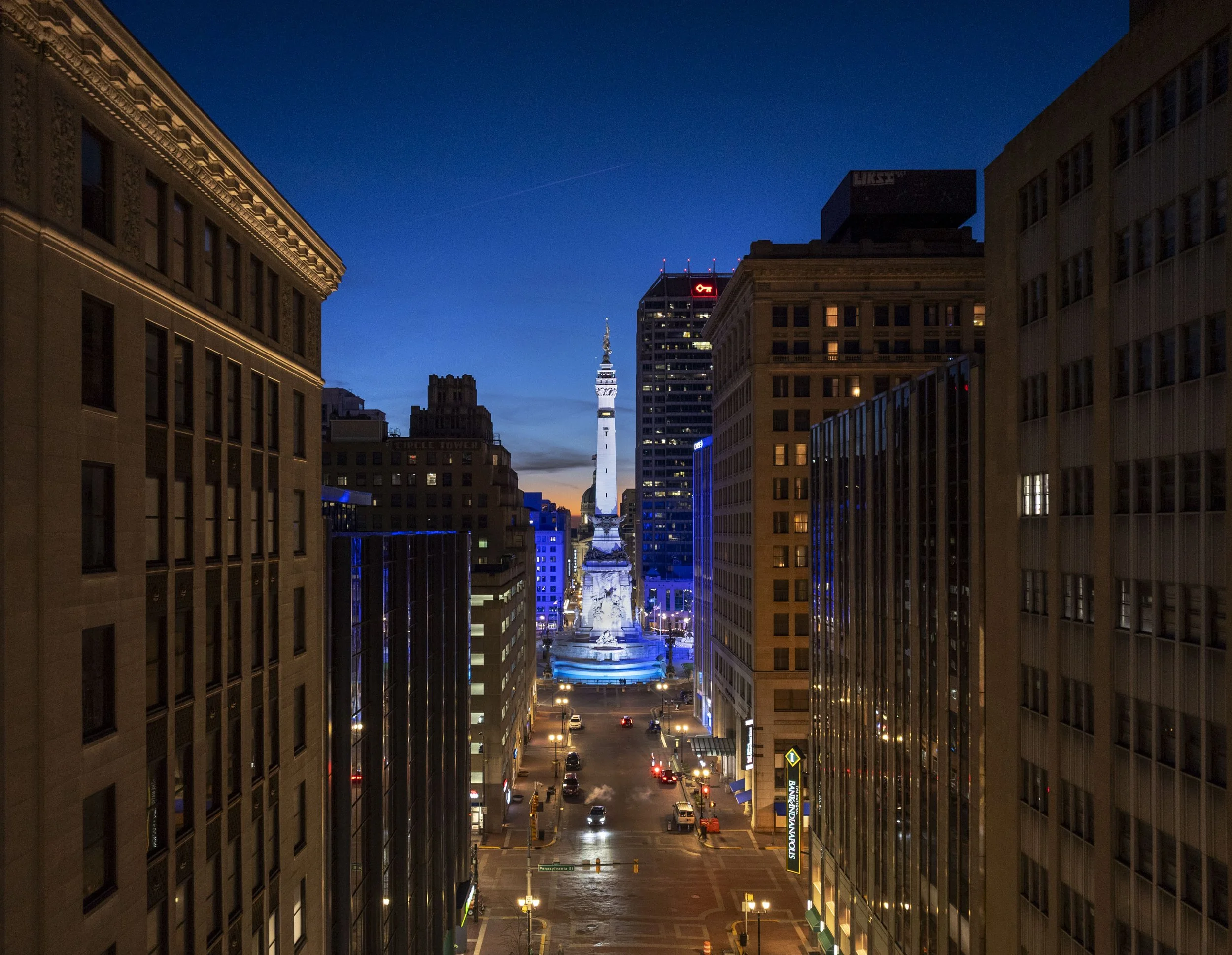
Above
The Soldiers and Sailors Monument illuminated at dusk in downtown Indianapolis.
Photograph by Hadley Fruits for Landmark Columbus Foundation.
“What does the monument know?”
This is both a silly question and a deep, interesting one.
Technically, the Soldiers and Sailors Monument is a 284-foot-tall arrangement of elaborately carved rocks and carefully cast bronze. It is unaware of the knowledge it stores.
But what if we pretend for a moment that the monument does have consciousness? Can you imagine all that it knows after sitting in the center of our city for more than one hundred and twenty-three years?
The Monument is the center of our civic life, literally and figuratively. It’s the central axis around which the city is structured. The memorial has seen the advent of automobiles and electric lights. It has witnessed countless events, both somber and celebratory. It has stood by for parades, protests, concerts, farmers markets, motorcycle rallies, and light shows. The monument has watched as the buildings encircling it have been constructed, demolished, and reconstructed many times over. So much history has transpired in, on, and around the Monument. It remains the most public and accessible place in our city.
When my friend and landscape architect Chris Merritt called me about a year ago to talk about the Monument, I began to ask myself what I knew about it, aside from its centrality. I’d read the basic history but had never thought about it in a deep or sustained way. My own engagement with the Monument had been surface-level at best.
A few moments from my personal history with the Monument:
2007
I flew to Indianapolis for a day from New York City to interview for a job at the art museum. As part of my orientation to the city, my future boss and friend Lisa Freiman drove me around Monument Circle. It was big! And kind of strange?
2009
An “Indy Culture Matters” rally was held at the Monument to raise awareness about the economic and social impact of local arts groups. I was part of the art museum contingent, wearing a custom t-shirt I wish I hadn’t lost.
2009–10
While the Indianapolis Cultural Trail was under construction, I served on the advisory committee that reviewed Fred Wilson’s proposed public artwork based on a figure of an enslaved man drawn from the monument. Following significant public dissent and fascinating if painful conversations, the project was canceled.
2011
For the first time, I took my son to see the Monument draped with lights for the holidays. I had always thought it strange that no one seemed to mind that a memorial to lost lives was routinely turned into a Christmas tree, but as little Henry looked up at the spectacle in wonder, I started to get it.
2017–20
This was a period of years I moseyed around the monument on empty Sundays after listening to my goddaughter sing in the choir at Christ Church Cathedral. Every time, I thought about going to the top of the Monument to the observation deck but didn’t. Then, pandemic.
2022
I went on a Sampson Levingston-guided Monument Circle Walk & Talk with my family on a very cold winter night, huddling up at Hilbert Circle Theater before and after. We learned so much, including that the Circle used to be home to the Governor’s mansion, but no one ever wanted to live there because where would you hang your laundry?
2024
Started visiting the farmers market on the Circle, picking up ube and pandan cookies at Salamat!, and afterward enjoying a one or two in the sheltering shade of Spark. How nice to be invited to linger there to take in the Monument and the activity surrounding it. Once again, I thought about climbing up to the observation deck and didn’t.
2025
In 2025, Chris shared with me the news that he’d been named an Emerson Collective Fellow, along with his collaborator Nina Chase. Together with the City of Indianapolis, they planned to reimagine the future of Monument Circle with a public realm plan that honors its rich history and shapes a more connected, welcoming future for the city. Merritt Chase collaborated with Big Car on Spark on the Circle, and wished to continue their exploration of the space and its potential. Chris and Nina invited me and my organization Monumental Gestures to partner with them on this work, so that we might help spur a wider conversation about what the Monument means to the people who live here today, what it meant historically, and which stories might be missing from it.
Monumental Gestures is a new organization working toward more ambitious and impactful public art in Indianapolis (and a proud arm of Landmark Columbus Foundation). As the Artistic Director of this organization, I tend to zoom directly toward ideas for how new art could reshape a space. With a site as iconic and central as Monument Circle, however, we all knew that a sustained and thoughtful public conversation would be essential before anything new or different could be proposed. Thus was born The Monument Knows, which is our effort to better know and understand this thing/place/phenomenon that is so central to our city.
There’s only so much any one of us can know about the Monument. With support from the Mellon Foundation, this project is our attempt to help grow a community engaged and invested in its future. Our first steps toward this are to:
Host four public conversations in 2026, featuring visiting national scholars and local leaders. Each event will be an exploration of Monument Circle’s history and present, seeking to integrate expanded histories and community voices into its interpretation and future planning. We’ll get to walk around the Circle and have drinks together, too.
Work with research partners to develop a custom artificial intelligence model that will enable the Soldiers & Sailors Monument to “speak”, sharing layered histories, archival photography, and public memory from multiple perspectives. It will be a key research tool of the project, enabling us to gather knowledge, explore ethical approaches to AI, and work to build an accessible model that aligns with how we learn today.
Both efforts aim to get Indianapolis talking not just about the Monument but with the Monument, engaging with its history and considering its role in our lives today. There’s much I have to learn, and I’d much rather learn in community with all of you than by my lonesome at my computer.
I hope you’ll join me at the Circle and consider this question:
What will you ask the monument?
◆◆◆
