A Monument and You, A Monument and Me
◆◆◆
Above
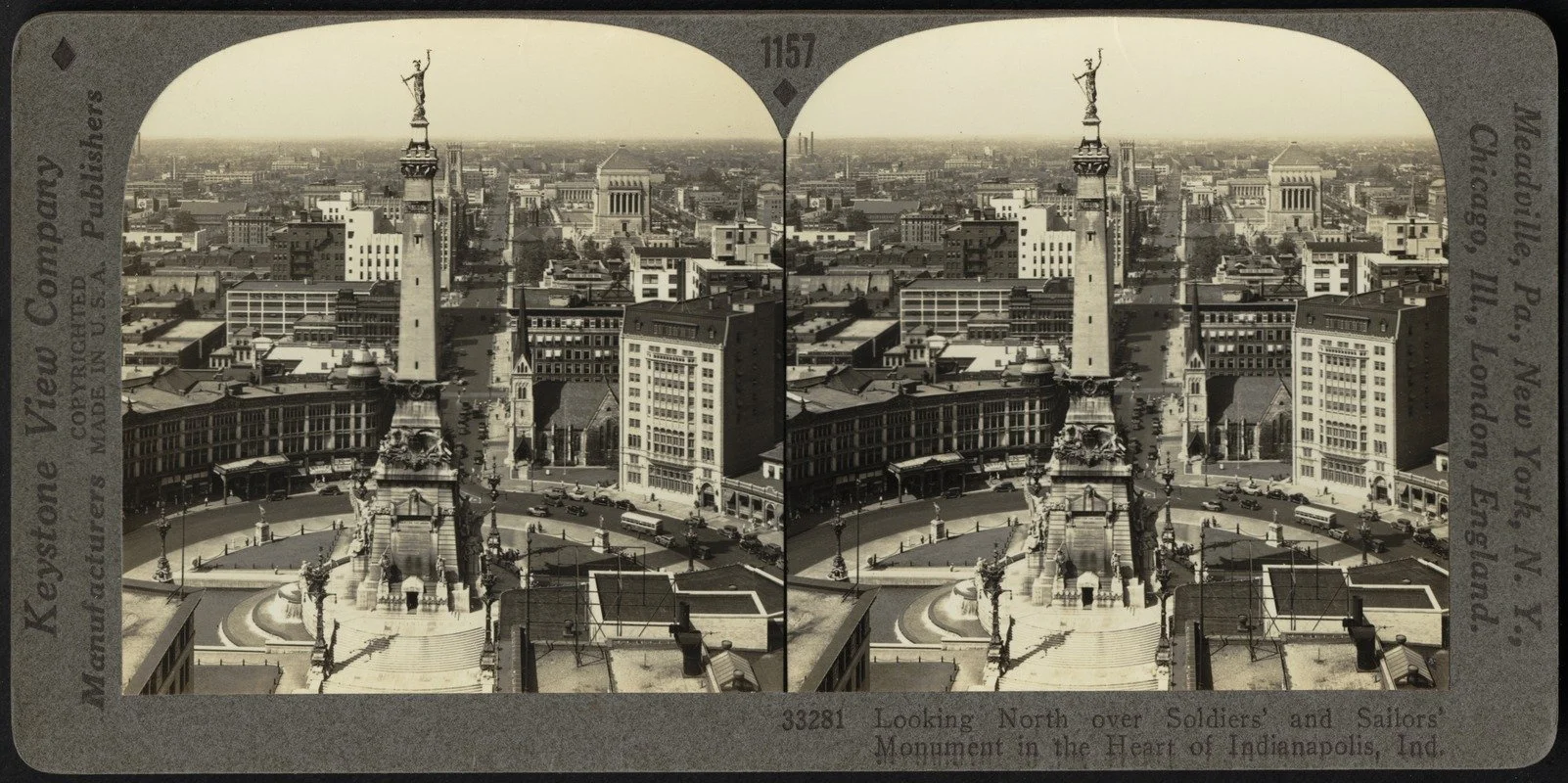
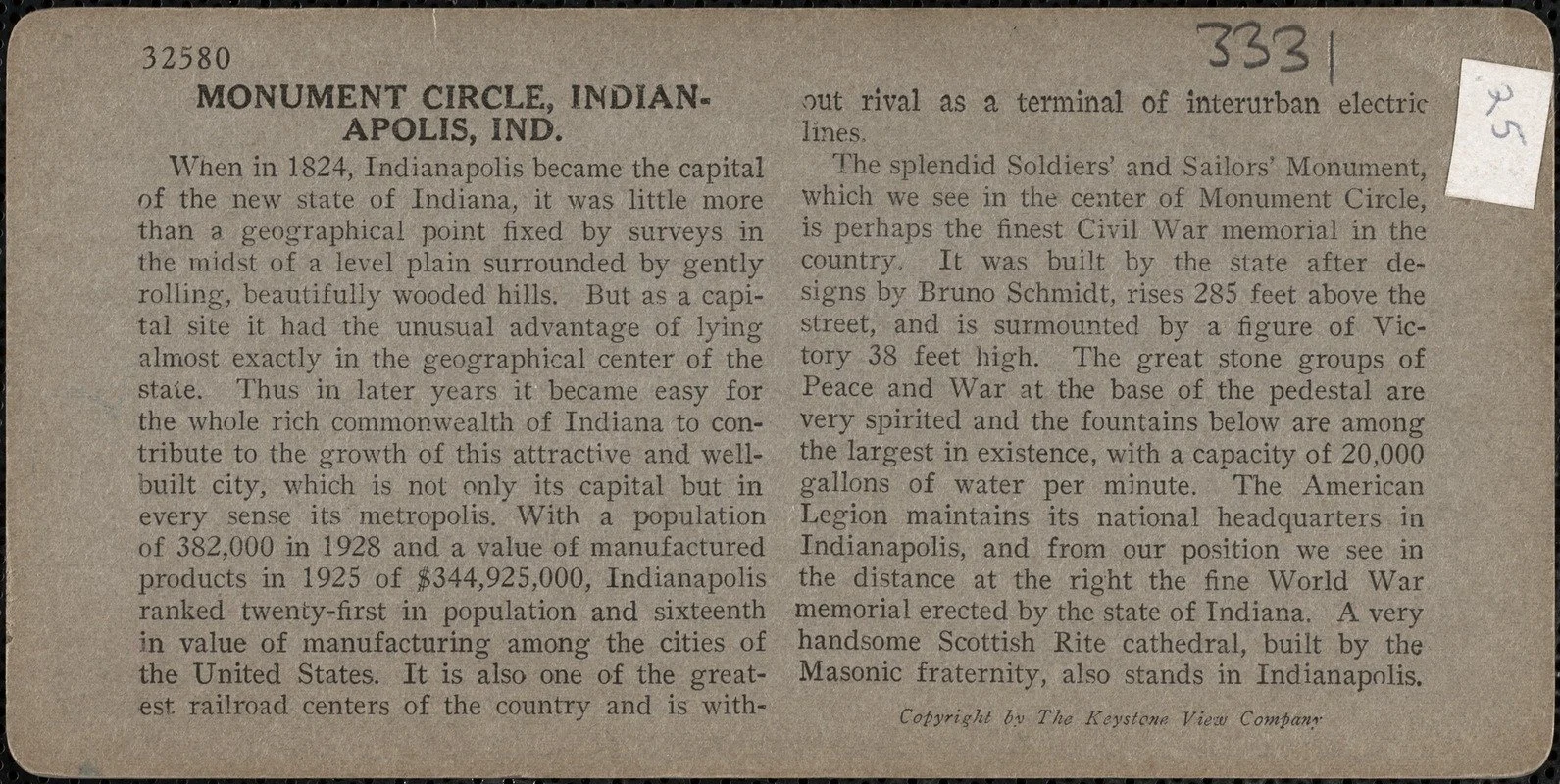
Figure 1. Front and back of a Stereograph card image of Monument Circle, “looking north over Soldiers’ and Sailors’ Monument in the heart of Indianapolis, Ind.”, c. 1930. (Image Credit: Keystone View Company/Boston Public Library/Public Domain).
Monuments. Structures of grandeur to highlight the legacies of people, periods in history, and important events (see Figure 1). But most of us pay little attention to this depth of what they are or why they exist. This is not out of some notion of disrespect and woeful ignorance, but it is simply because this is not how most of us live our lives. Monuments are wayfinding points to not get lost or to indicate we have arrived at (or near) our destination. They are reminders of moments in our own histories and experiences that mean something to us. So, before they are monuments of legacies, history, and events for a society—our society—they serve us in very intimate ways.
We know the location of a monument. We may even know the full, true name of a monument. But what we know the most is that they serve as a focal point for the lives we have lived and the lives we will live. There it is standing prominently downtown, the Indiana State Soldiers and Sailors Monument, a shrine to the fallen of wars of the past. Veterans come to it every evening to salute their fallen comrades that still weigh heavily on their minds. Booming speakers rattle and glare out a speech and the instrumental to a national anthem. And while that sound fills our very being with its boisterous volume in Monumental Circle any evening, for those who know of battle and know of loss, that sound cannot match the emotion that already fills them prior to even arriving.
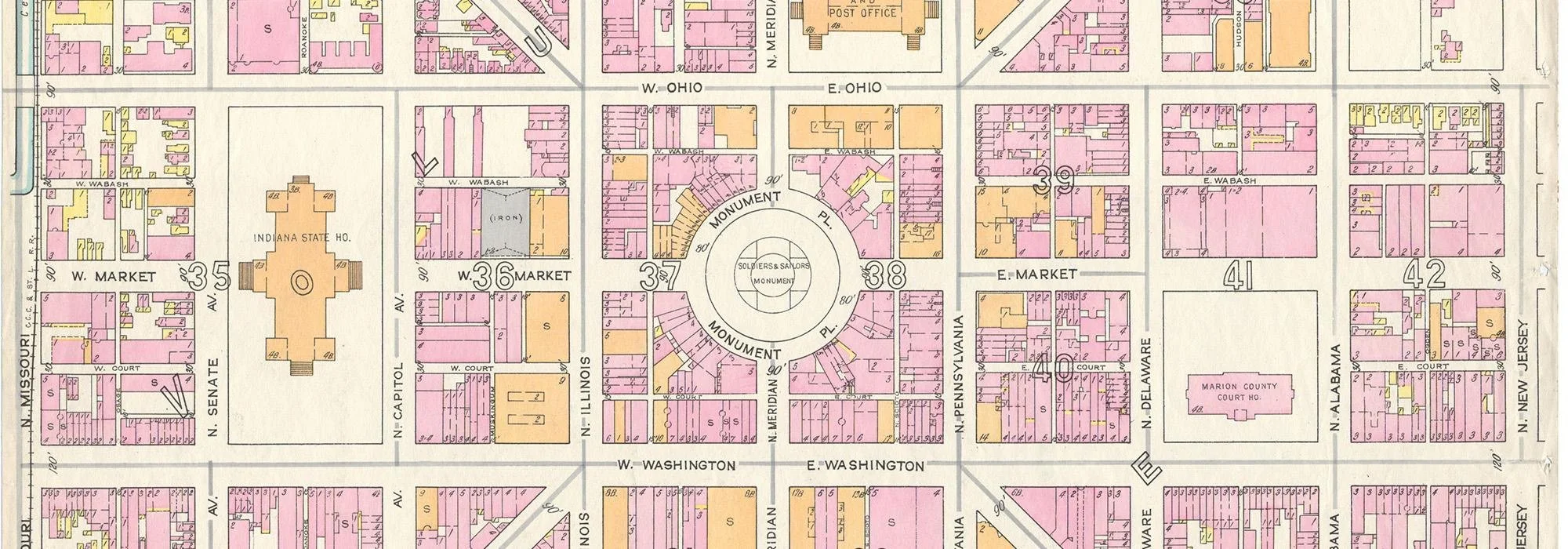
We know of it as an image in the backdrop of selfies, portraits, group shots, and scenic photographs. We have seen the images of others on social media platforms. We have seen the official images of tourism and hospitality entities featuring the Monument as one of the primary distinguishing features of Indianapolis’ infrastructure. We have seen it on televised portions of sporting events before or after commercial break. We have seen the photo albums of family members who captured the night of their prom, the morning of early run, the afternoon of their birthday party, or the day of their wedding. There it was in each image, standing behind them. A monument and its circle that has generated an endless cycle of years of photographs and images (see Figure 2).
Above
Figure 2. Alexander Ralston’s Plan for Indianapolis, a commission to design a new layout for a new city, thereby creating the Mile Square that is known today, 1821. (Image Credit: Sanborn Map Company/The Cultural Landscape Foundation/Public Domain).
We told others to meet us there, then, and at that site. The site to meet for that first date at the steakhouse, before the order of shrimp cocktail, and after the $4 drafts, $2 wells, and ½ price whatevers. The midway point of getting a good or bad parking spot. The resting spot of horses and their carriages. The rallying point of hundreds of motorcycles, thousands of bicycles, scores of tricked-out cars, and quite a few competing sound systems. The landmark that indicates the finish line is near for an annual marathon. An identifying location for tasty chocolate, coffee breaks, feet resting, cash machines, bird feeding, and the freedoms of speech. A site for the dinner parties dressed in all-white, dance parties outfitted in all-black, orchestral promotions of dancers performing salsa and ballet, and parades of debutantes, royal courts, grand marshals, mayors, and key to the city honorees.
We remember that one school field trip to downtown and all of its surrounding monuments. We know the walking that takes places in tours around the Monument. We can feel the hairs on our neck hearing the ghost stories and the sounds of phantoms emanating from the Monument. We were there for the Super Bowl, the post-Super Bowl, WNBA Championship, and NBA Eastern Conference Championships win. We stood as the “I” on one of the first NDY! platforms. All the meetups for run clubs, dog walkers, outdoor yoga studios, antique bicycle aficionados, and bachelorette night outs. A perfect location for the Strawberry Festival, Indy Pride, Sol Sessions, the Big Gay Market, and SPARK on the Circle. And there is always the Circle of Lights.
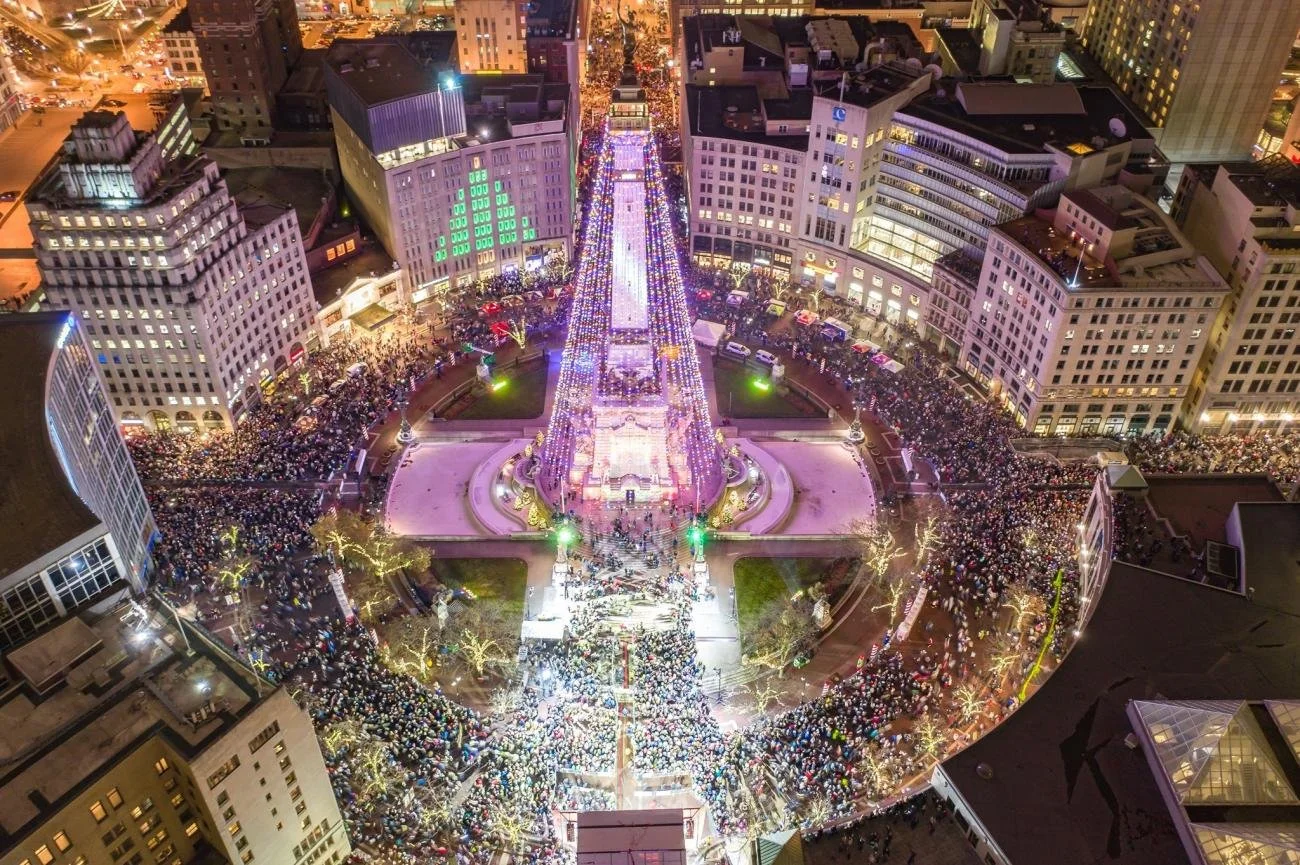
Nearly 5,000 multi-colored LED lights are draped around this 284-foot monument for the benefit of millions of visitors (see Figure 3). Nearly 1.6 million visitors to the monument have looked out the windows of the glass-enclosed observation deck that took 330 steps to get to. And it takes 2000 steps from all directions to arrive at the circle, the true middle of the city of Indianapolis’ downtown Mile Square plat. And just under 1 million residents of the city have 1 million stories, experiences, and meanings for what the Monument is to them. Some are mundane. Some are obscene. Some are jubilant. Some are incredible. But each are valid in their own way, especially to the owner of those stories, experiences, and meanings.
And perhaps this is what a monument actually is or what it should be for a modern age. Not necessarily erasing its origins or its original purpose, but a monument stands as something for you and I to ascribe what we wish to make of it. A monument stands as a possible focal point for a community, a society, and a city that may not have a unifying reason to exist. A monument stands as a possible focal point for possibilities.
Above
Figure 3. The 58th Annual Circle of Lights event that converts the Soldiers’ and Sailors’ Monument in a giant Christmas tree, December 2021. (Image Credit: Public Domain).
For 17 years, I lived right around the corner from Monument Circle in a street-facing apartment on Washington Street. For 17 years, I never once ventured to the observation deck of the Monument.
For 17 years, I never once pitched a penny, nickel, dime, or quarter into either of its ponds for a wish. I would be hard pressed to remember any notable events, over the span of 17 years, that I attended on the Circle, or intentionally planned to attend on the Circle. For 17 years, the Circle was an inconvenient or convenient roundabout as I returned home. Over the span of 17 years, I may have entered the doors of the Starbucks, Downtown Comics, Potbelly, Chocolate Café, or Au Bon Pain that either once or still inhabits a storefront around the Monument’s perimeter, only once. I may have withdrawn cash from the FORUM Credit Union or the Chase Bank ATM, once or even twice. But during the lockdowns and curfews of COVID-19, this Circle was my refuge from the pressure of the closing-in walls of my then no-longer-spacious apartment. The stairs were an outdoor chair in the earliest part the morning hours or the latest of nightly hours. The circular sidewalk around the perimeter, the brick lane of the street, and the pathway proximate to the stairs of the Monument were my beginnings of walks that I still maintain to this day, no matter where I go, everywhere I go. The Monument waited 17 years for me to recognize it and recognize what it could mean uniquely to me.
A monument for you, and a monument for me.
◆◆◆