Monument in the Making: The 20 Year Effort to Establish Monument Circle in Downtown Indianapolis
◆◆◆
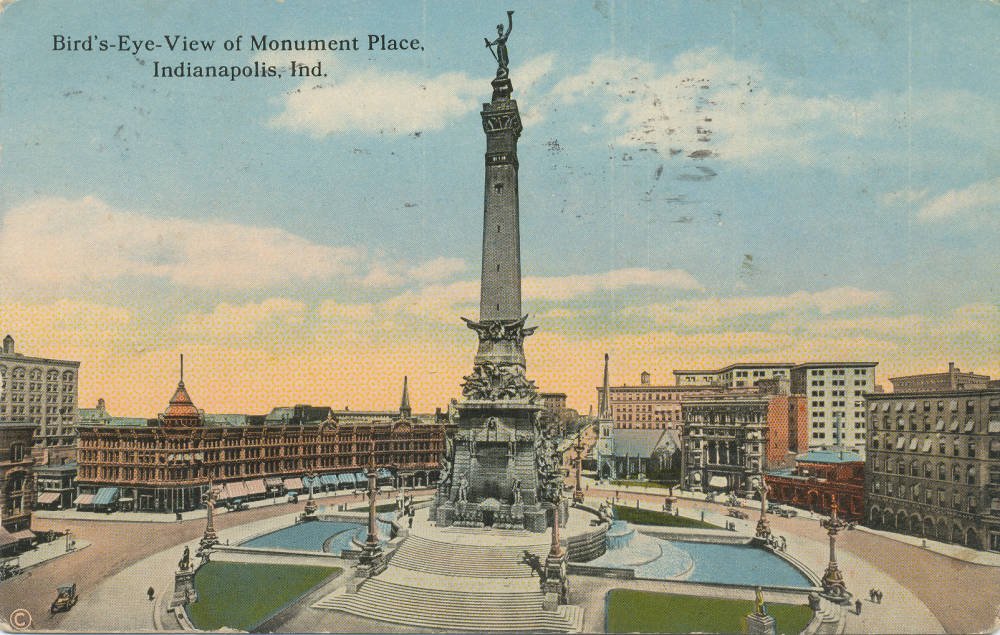
Above
1916 Postcard of the Circle and completed Monument. Credit: Indianapolis Special Collections Room, Indianapolis Public Library.
The State of Indiana contributed over 200,000 soldiers and sailors to the cause of preserving the Union and putting down the rebellion of the southern slave states during the Civil War. Celebrations were had and grateful speeches made upon the end of the war in the spring of 1865, but for the first several years after the war’s end, there was no memorial or monument to those who served during the conflict. But there was a national holiday for such a purpose, Memorial Day, also known as Decoration Day, which was first observed in 1868. But a physical recognition of the valor shown by Indiana’s soldiers and sailors was missing, although the relatively new holiday gave rise to discussions about a possible memorial. Decoration Day in May of 1871 brought one of the earliest public declarations in support of a monument. During ceremonies for the holiday at Crown Hill Cemetery that year, General George Chapman, a Union Army veteran and local judge, announced that the executive committee for the day’s ceremonies had passed a resolution asking that the State of Indiana “erect a soldiers’ monument in Circle Park.”(1)
This suggestion yielded little results at first. But in advance of the next Decoration Day in 1872, the idea began to circulate and gain steam. “Parties are endeavoring to agitate the project of erecting a soldier’s monument in Circle Park,” reported the Indianapolis News in a news brief.(2) Indeed, groups were advocating for the monument, and suggestions were made for a two-part fundraising effort to raise the estimated $100,000 cost: First, to prevail upon the state’s General Assembly for a $50,000 allocation, and secondly, the remaining balance would be obtained from private donations. The location in Circle Park was also notable. The Circle had been part of the original plan for Indianapolis and was a significant feature in the middle of the Mile Square grid of the city. It had at first been the site of a mansion for the state’s governor, but after that structure was demolished in the 1850s, without ever being lived in by a governor or their family, the land was converted to a park, creating Circle Park. With it prominently placed in the heart of the city, the park was recommended as the best location for a monument and by the 1870s, was described as “of no practical use at present, and there is no likelihood that it ever will be...”.(3)
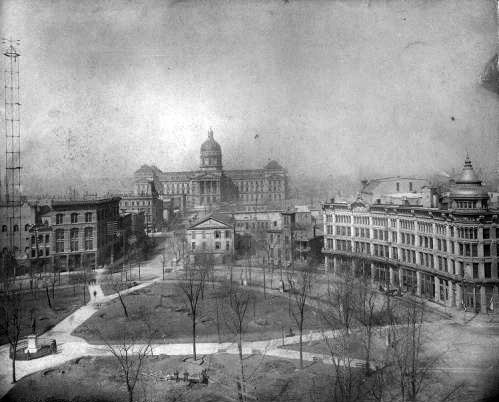
Above
Circle Park before the Monument. Credit: Indiana Historical Society.
The Indianapolis News cheered the project and was later joined by its in-town competitor, the Indianapolis Journal, in expressing support for a monument. However, the enthusiasm waned. Perhaps the catastrophic Panic of 1873 played a role in the proposed monument’s delay. Striking the United States in the fall of that year, the panic led to a multi-year depression, characterized by bank failures, high unemployment, and generally poor financial conditions. Little was done until the fall of 1875 when General John Coburn, another veteran of the Civil War and the head of a so-called Soldiers’ Monument Committee called a meeting of the committee. The News noted hopefully that nearly all the members of the committee were to attend, and that “the enterprise is taking shape for final success.”(4) This optimistic outlook was short lived, and aside from the committee renaming itself as The Soldiers’ and Sailors’ Monumental Association, few concrete steps were taken for another several years, until the early 1880s, when the Grand Army of the Republic organization took up the cause.
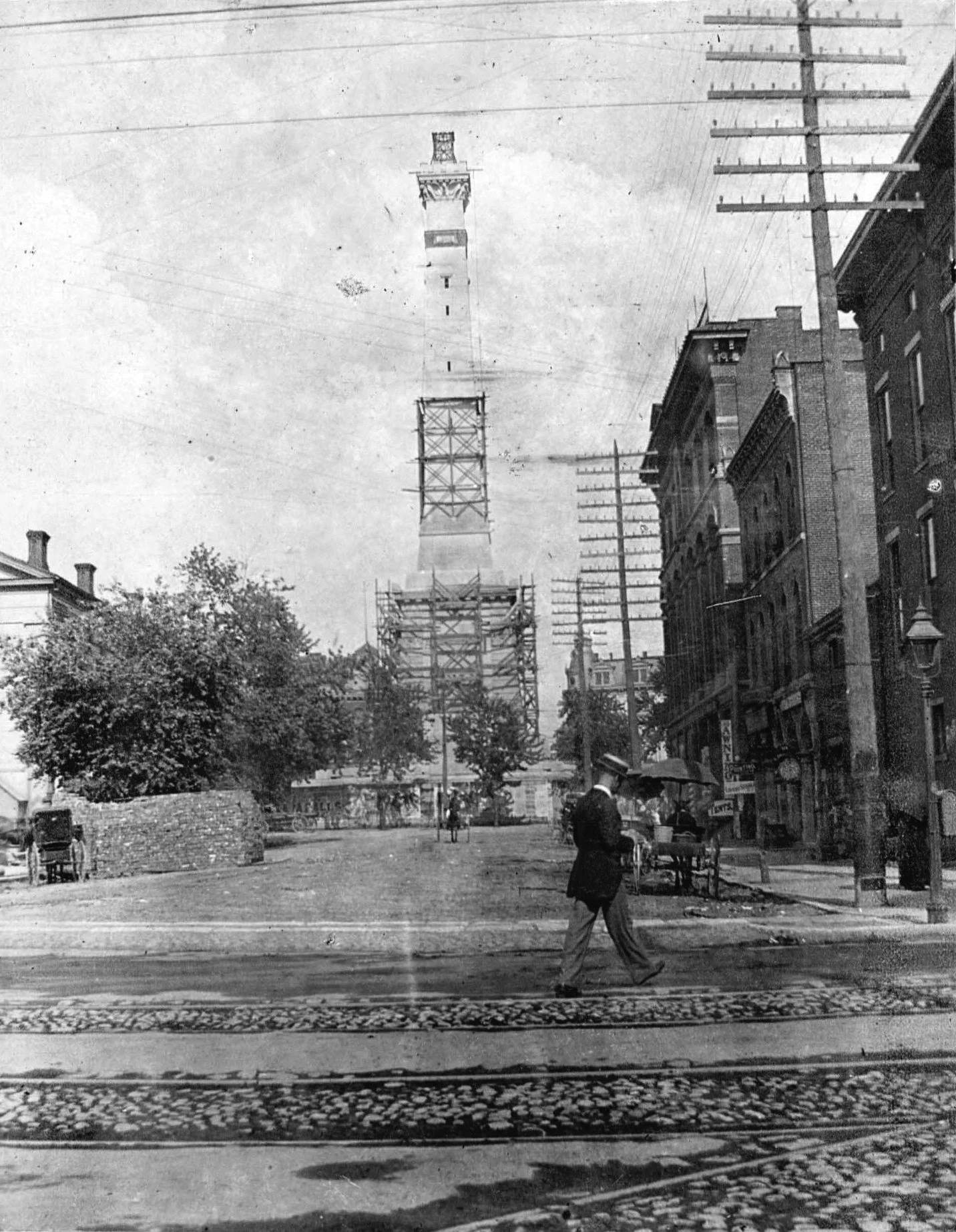
Above
General photograph collection, Rare Books and Manuscripts, Indiana State Library
The Grand Army of the Republic, or GAR as it was colloquially known, was a fraternal organization of Union Civil War veterans, similar to the American Legion or Veterans of Foreign Wars that we know from our more recent history. The GAR was established on April 6, 1866, nearly one year after the surrender of Confederate forces at Appomattox Courthouse in Virginia. The GAR had posts located in communities across the northern states, and in addition to statewide meetings, would hold National Encampments in major cities, including several encampments in Indianapolis. Representing the interests of the veterans for whom the proposed Soldiers’ Monument was intended to honor, and wielding significant political power, the monument seemed on the verge of reality. In August of 1882, the Indianapolis GAR post issued a proposition for the construction of a soldiers’ monument in the city. The proposition was approved by the GAR’s administrative council who appointed General James Carnahan, the head of the Indiana Department of the GAR, as president of another committee to advocate for the construction of a monument. A fundraising goal of $20,000 was established with the intention that half of this amount would be raised from the over 90 GAR posts in Indiana, with the General Assembly providing the remaining funding. The involvement of the GAR helped fuel increased focus on the proposed monument, not only amongst the public, but also with state officials.
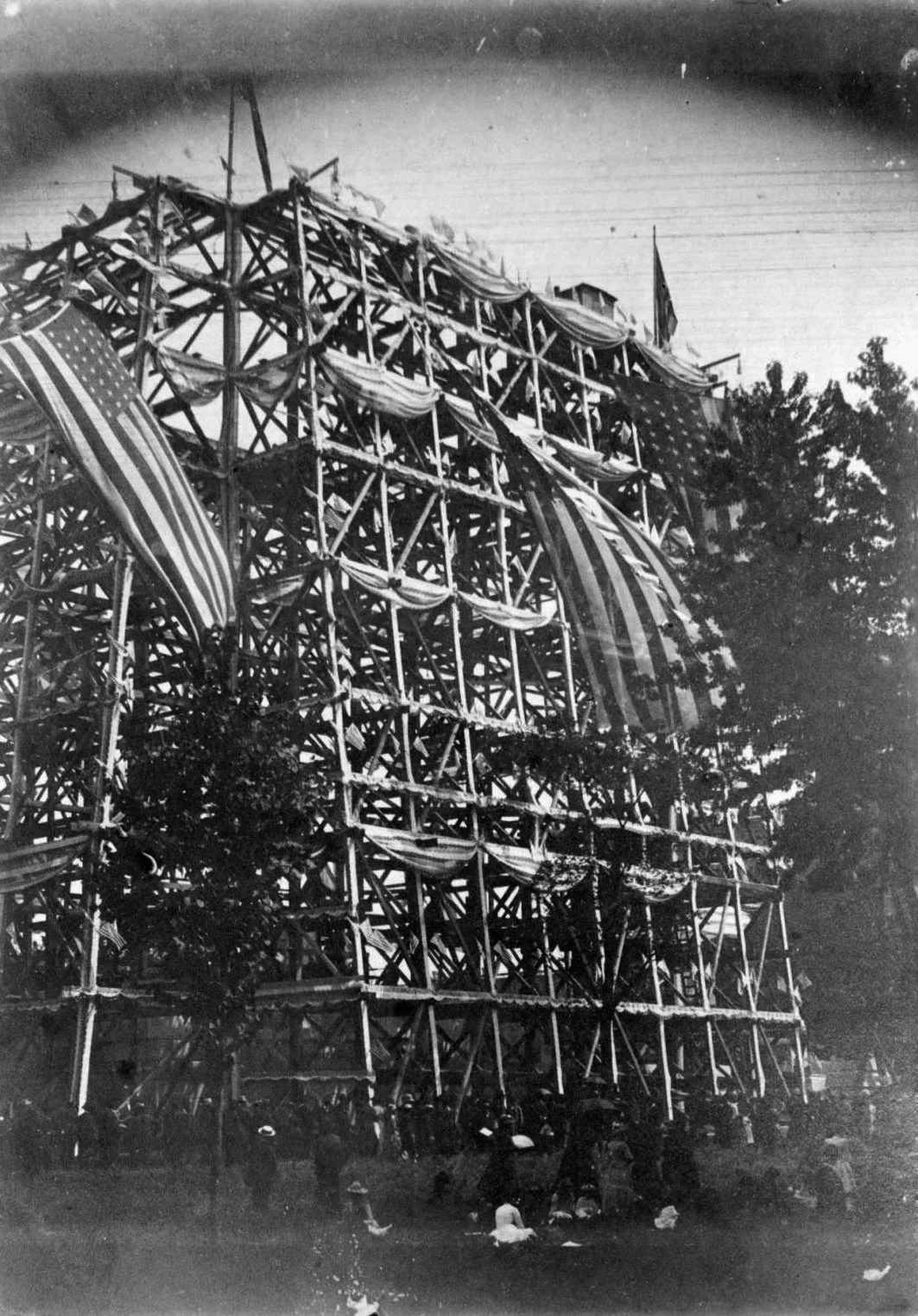
Above
General photograph collection, Rare Books and Manuscripts, Indiana State Library
But before any Soldiers’ Monument was constructed, a different monument was placed at the center of Circle Park: a statue of Oliver P. Morton, mounted atop a stone pedestal, and situated in the middle of Circle Park at the intersection of several of the park’s walkways. Morton had been Indiana’s powerful war time governor during the Civil War, celebrated for his dedication to the Union cause, and was later appointed to the United States senate from Indiana. He also made one of the earliest proposals for a monument to those from Indiana who fought in the Civil War. Morton suggested the monument as part of his address to the Indiana General Assembly on January 11, 1867, when he proposed Crown Hill Cemetery as the site for such a monument: “In this Cemetery there is a high hill quite overlooking the city, and I recommend that upon this hill the State erect a monument in memory of her brave soldier who perished in the rebellion,” said Morton. A monument atop Crown Hill would have been a grand sight, and Morton noted that “[t]his monument overlooking all the country around would be the first object to greet the eye of the traveler as he approaches the capital...”.(5)
Morton’s proposal was not pursued at the time, but in the midst of the celebration for the statue memorializing the deceased war governor, the movement for the proposed soldiers’ monument would receive a significant vote of support. One of the speakers for the dedication held on January 15, 1884, was future president of the United States Benjamin Harrison, then in the middle of his first, and only, term as one of Indiana’s senators. Harrison had served in the Civil War, leading Indiana soldiers in the war’s western theater in Tennessee and later Georgia and had reached the rank of brigadier general of volunteers. Prior to the war, he had practiced law in Indianapolis, an occupation he would return to after the war, and prior to his rise in politics.
During his comments on the occasion, Harrison reportedly suggested that an additional, companion piece to the Morton statue be constructed, “an impersonal statue, one upon whose base no name shall be written, upon whose summit shall stand the typical soldier of the nation.”(6)
Harrison’s speech and call to action were well received. “The veterans of Indiana, alive and dead, than whom the armies of history never had more heroic have won for themselves a fame, a renown that can never perish so long as history of heroic deeds shall endure,” wrote the Indianapolis Daily Journal. “But they deserve some material memorial that shall stand at once a monument to the glory they achieved and to the honor they brought upon their state.”(7)
Above
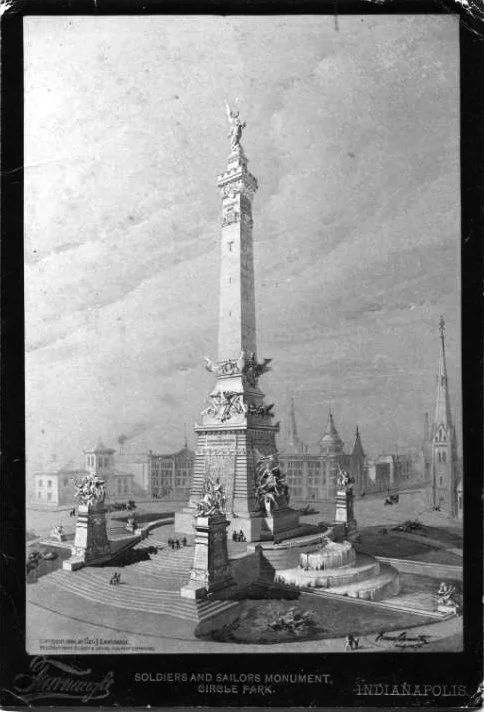
Rendering of Proposed Soldiers Monument. Credit: Indiana Historical Society
In 1887 the General Assembly finally took action and created the State Soldiers’ and Sailors’ Monumental Commission, which was tasked with selecting a design for the new monument, and more generally, moving the proposed monument forward. The members of the Commission were drawn from across the state, and a group of three advisors, who were knowledgeable in areas of engineering and design, were also selected to assist the Commission with their work. However, the General Assembly failed to approve a budget for the state in 1887, and the Commission was informed that funding for their work, and for the monument, should not be expected until after the next session of the General Assembly.
While funding matters remained pending, steps were taken for the selection of design. The Monument Commission sent letters seeking design submissions to ten prominent architects and firms, while advertisements were also run in newspapers across the country and in Europe soliciting potential designs. 70 designs were received in response to these efforts. The commission also reportedly collected several hundred photographs of “the most celebrated monuments in the world,” for review and to aid in what was described as a “proper judgment” on the monument’s final form.(8)
On January 27th, 1888, the Commission, after spending three weeks reviewing submitted proposals (the identity of the architects was kept anonymous during this process), approved a design identified as “Indianapolis No. 4” and titled “Symbol of Indiana,” which was revealed to have been submitted by Bruno Schmitz, a Prussian architect hailing from Berlin. The runner-up submission came from an architect in London, who received a $500 consolation prize. Schmitz’s winning design was described by the Indianapolis News as a “lofty shaft, with a high ornamented capital, supported by a pedestal with steps and terraces below, and very elaborately carved.” Schmitz later arrived in Indianapolis to receive his contract for the monument. Frederick Baumann of Chicago was appointed to assist in the construction as Schmitz’s deputy, since Schmitz would not be able to always be onsite during the construction. The Monument would be one of only two projects Schmitz completed in the United States, the other being a building at the St. Louis World’s Fair. Various artisans were also retained for the fabrication of stonework, statuary pieces, and metal components for the Monument.
Above
General photograph collection, Rare Books and Mansucripts, Indiana State Library
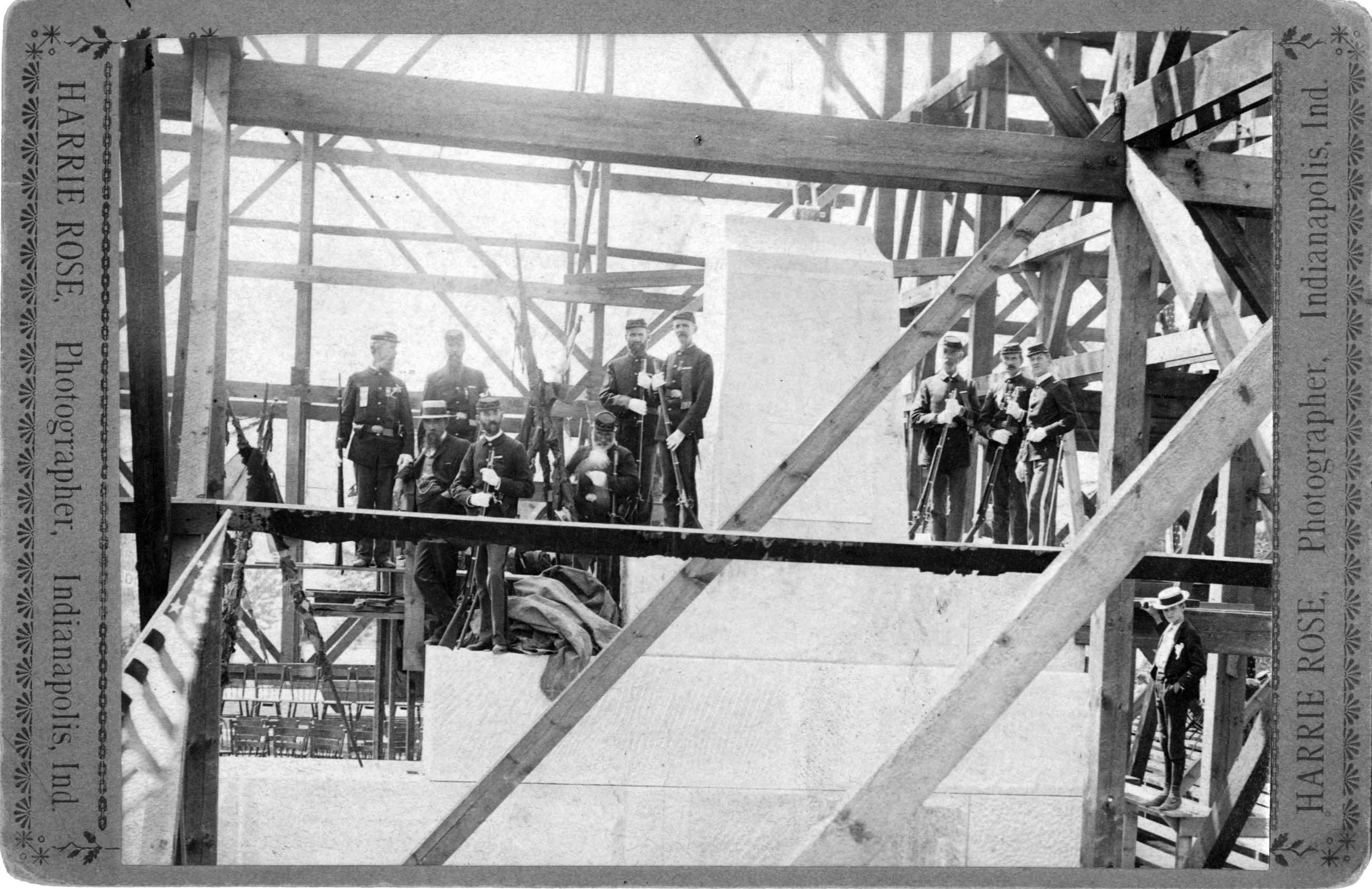
The General Assembly had also decreed that Circle Park would definitely be the location for the new Monument. The park was cleared of its natural spaces, pathways, and the Morton statue (later relocated to the southeast quadrant of the Circle), and the foundation for the Monument was laid in 1888. On August 22, 1889, the cornerstone of the new monument was placed to great fanfare. On its face read the inscription “Erected by the People of Indiana; Act of the General Assembly, March 3, 1887.” Over 20 years since Governor Morton’s suggestion for a monument to honor Indiana’s Civil War veterans, and more than a decade since the abbreviated attempts to garner support for the cause of a Monument in the 1870s, the Soldiers’ and Sailors’ Monument, and Monument Circle, was finally becoming a reality. However, it would take another thirteen years, until 1902, for construction to be completed and for the Soldiers and Sailors Monument to have its grand dedication in what would now be known as Monument Circle.
Bibliography
Indianapolis News, May 31, 1871
Ibid, May 13, 1872
“Soldiers’ Monument,” Indianapolis News, May 15, 1872
Indianapolis News, October 28, 1875
Documentary Journal of the Indiana General Assembly, 1867
“The Morton Statue Ceremonies,” Indianapolis News, January 16, 1884.
“A Soldiers Monument,” Indianapolis Journal, January, 18 1884.
Conklin, Julia Stout. Indiana Soldiers' & Sailors' Monument. Indianapolis: Hollenbeck press, 1900.
Additional Sources
Rose, Ernestine Bradford. The Circle, the Center of Our Universe. Indianapolis: Indiana Historical Society, 1957.
The Indianapolis News Souvenir; Dedication Ceremonies and History, Indiana Soldiers' and Sailors' Monument, Indianapolis News, 1902
◆◆◆